Editor’s Note: Below is a summary of the recently released 2021-22 Annual Report for the Sierra Nevada Bighorn Sheep Recovery Program. This report shows a very positive view of the sheep from 21-22 but as we know last winter about 50% of the SNBH died.
Excerpts from the report:
For the second consecutive year, the range-wide Sierra bighorn population increased, reaching 277 females. Although still short of the highest count of 316 females in 2016, the growth of most herds this year indicates a rebound from the heavy winters of 2016-17 and 2018-19.
In addition to summer surveys, we were able to have both spring and fall bighorn captures. In the spring, we successfully translocated 7 bighorn from Baxter to Laurel including 4 females, 3 of which were pregnant.
In the eastern Sierra region, we accounted for 55 mountain lions which exceeds the highest count from last year of 54. This includes the highest counts ever for three of the four count areas: northern, central, and Olancha.
We published a rigorous evaluation of disease risk to Sierra bighorn. This new method considers the likelihood of Sierra bighorn movements when identifying potential overlap between Sierra bighorn and domestic sheep.
The same newsletter page also carries the closing paragraphs of Rick Ianniello’s White Mountains survey report, CDFW Surveys the White Mountains — Fall 2023:
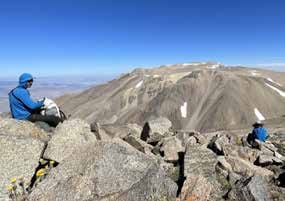
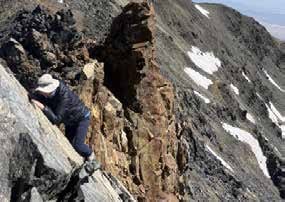
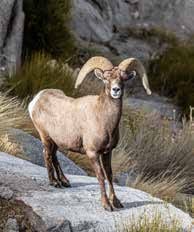
The sheep were fat and healthy, with many yearlings and lambs. Given the abundant low elevation, west facing habitat available to the White Mountain Sheep, it’s unlikely the big winter had much negative effect. However, the GPS collars we used in 2018-2020 to estimate the population as one of the biggest in the state at around 400 sheep have all failed, making such an estimate impossible this year. This fall, we plan on adding another 24 collars to the range for future estimates and continued monitoring.
In other news, we conducted our first in person hunter orientation in four years on Saturday, August 12th! We’d like to extend a huge thanks to the Society for the Conservation of Bighorn Sheep and California Wild Sheep Foundation for presenting and providing lunch.
In addition to our new drought scientist, Ben Carter, we have two additional scientific aides, Riley Johnson and Samantha Stelton, who will be helping us collect the nearly 100 cameras we deployed over the summer, and to prepare for this fall’s captures in the White Mountains and surrounding northern ranges.