California Fish and Wildlife update and White Mountain survey.
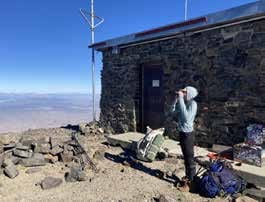
At 6am, August 8th, it was 72 degrees in Bishop. At 11,700ft in the Whites, it was below freezing. Lucky to be on official business, we drove past Barcroft Gate to the last turnaround before a giant snowfield below White Mountain Peak. Dr. John Wehausen and our newly hired drought scientist Ben Carter took the vehicles south to survey along White Mountain Road. Our group of five headed north, with three days to survey before the next round of forecasted thunderstorms.
Almost immediately, a group of twelve ewes, yearlings, and lambs rounded a ridge and bedded below us, unconcerned with our presence. These “switch-back sheep” are habituated to human traffic on California’s third highest peak, and I suspect they use the area as a semi-refuge from mountain lions that prefer to keep their distance from hikers, bicycles, and trucks.
From there we took our packs, loaded with food, cold weather gear, spotting scopes, tripods, binoculars, and telemetry equipment north across the Knife’s Edge: the only narrowing of the White Mountain’s Crest between Mount Dubois and Westgard Pass. We scrambled along its top for half an hour, before reaching a narrow ledge that cuts over a fifty-foot precipice. Passing our bags between each other allowed us to traverse the exposed spot unencumbered, and solid foot and handholds made the traverse manageable.
The White Mountains hold many sheep, but even more terrain to glass. By 8pm, when we reached our campsite at Birch Creek Saddle, exhausted, we had seen no more sheep than the dozen switch-back sheep. What we saw was endless green, along the crest, in the flats to the east, and off the steep disappearing slopes to the west. In a typical summer, the Whites are drying up by mid-August, and though forage is still available, it’s limited to the high flats where sheep are easy to count. But this year wasn’t normal. The only slopes uncovered by green grass and bright flowers were the steep eastern slopes, still half coated white by old cornices and snowfields from the historic winter.
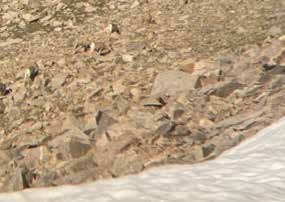
Our luck fared better in the second half of the survey and combined with a group of 14 that John and Ben saw, we counted 72 desert bighorn this year in the Whites. While in previous years we counted over 200 sheep on this survey, widespread green-up is better for sheep than for count. With steep, difficult terrain, covered in grasses and flowers, we expect many bighorn sheep grazed tucked away in steep canyons off the west side. In fact, the 14 rams we counted were doing just that. We only spotted them after descending 2,000 feet down the side to retrieve an old collar! So, wish some luck to the White Mountain hunters this year. They may need it!